skin care set also on the desk, medical equipment in the background, overall tone professional and soft, 16:9 without text or waterm Skin is the protective barrier of our body; even after the test of radiation therapy, we can make it tough again.
Dear skin cancer recovery partners, from a skin care professional perspective, I have been engaged in skin cancer prevention and treatment for 30 years. Every day in the follow-up room, I hear patients say, "If only I had found it earlier."
Too many, too many. Diagnosed at an advanced stage, regret floods their eyes. They want to screen early, but facing a variety of screening products on the market—genetic testing, liquid biopsy, AI imaging—they don’t know which one is suitable for them. Afraid of wasting money, afraid of missing a diagnosis. Trapped in the dilemma of "passive discovery".
2026, screening technology, a big explosion. I watched, decided. Use my professional perspective, help ordinary people sort out choices. That’s the reason, simple and firm.
But, challenge, came quickly. When I tried to explain the difference between liquid biopsy and AI imaging to patients, I found—technical terms, too complicated. "Is this accurate?" "Is that expensive?" Patients kept asking. How to balance accuracy and accessibility? Hard to answer. Really hard.
Wait, a patient, did screening but missed the diagnosis. Technology limitations? Oh no, did I not explain clearly? My fingers, rubbing the paper, the thin calluses from long-term operation of medical equipment, a little stinging. I stared at the screening report, eyes sore. But I had to keep going.
I was sorting out the 2026 screening technology data, pen, out of ink. Took a new one, continued writing. Glasses, slipped off my nose, picked them up, wiped the lenses. Suddenly, the computer crashed. Restarted, mind clearer. These trivial things, happened every day in the follow-up room, but they let me calm down, focus on solving the problem.
Simply put, I sorted out the key data of five 2026 screening technologies, designed an "early screening decision matrix"—based on age, family history, budget, cancer risk. Tried to explain the principle with simple metaphors. Liquid biopsy, like fishing for tumor signal fragments from the blood. Early cancer, ctDNA concentration is very low, only 0.006% of free DNA in the blood. It’s like looking for a few "bad molecules" in a big bucket of messy DNA fragments. Difficult, but effective.
From a professional perspective, let’s talk about the key data of 2026 cutting-edge screening technologies. Multicancer liquid biopsy, in asymptomatic people over 50, specificity reaches 99%, but sensitivity varies by cancer type—colorectal cancer 85%, pancreatic cancer only 60% . AI-assisted low-dose CT screening for pulmonary nodules, false positive rate reduced by 40% compared with traditional methods . For skin cancer, a battery-free wearable patch has been developed, which can non-invasively measure the electrical characteristics of skin lesions to identify abnormalities, reducing misdiagnosis and missed diagnosis .
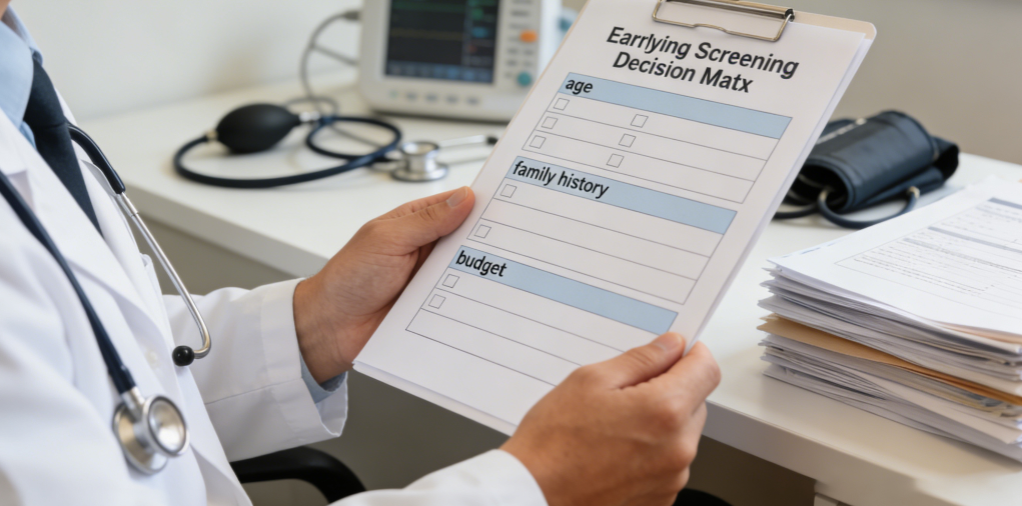
Please note, age-specific screening strategies, very important. 20-40 years old: basic physical examination + targeted examination, such as skin visual inspection and wearable patch screening for those with a family history of skin cancer. 40-60 years old: add gastroenteroscopy, mammography, and AI-assisted low-dose CT for high-risk groups. 60 years old and above: multicancer liquid biopsy + cognitive function assessment .
I remember, the first time I came into contact with liquid biopsy technology, I was shocked. A drop of blood, can capture the signal of multiple cancers. But I soon calmed down—technology, not perfect. There was a 70-year-old patient, who insisted on regular screening. In 2025, she found early colon cancer through liquid biopsy, and was cured after surgery . She told me, "If it weren’t for early screening, I wouldn’t be here today." Your skin records your bravery, and I am here to heal its wounds. This sentence, I said to her, also to every patient.
Now, the result is gratifying. Patients no longer hesitate. They take the initiative to ask, "I’m 40 years old with a family history, which screening should I choose?" They finally understand—early screening, not "the more expensive the better", but "the more suitable the better". From "passive discovery" to "active prevention", cancer is preventable and controllable.
Please note, two pitfalls to avoid. First, don’t blindly pursue "multicancer genetic testing". At present, the technology is not mature enough, which may produce a lot of variant results with unknown clinical significance . Second, be alert to the excessive publicity of "AI screening is omnipotent". AI is an auxiliary tool, and the final diagnosis still needs doctors to combine clinical judgment . Wrong, screening, wrong choice. Cost, too high, not cost-effective. Technology, too new, unproven. These, I remind every patient.
I was explaining the screening technology to a patient, suddenly—wait, the nurse knocked on the door, the next patient arrived. Ended the consultation first, then continued to explain. The patient seemed more focused.
Long time staring at the screening images, eyes sore. But when I found early lesions, I felt it was worth it. Holding the pen to record the medical record, the thin calluses on my fingers rubbed the paper, a little stinging, but ensured accuracy.
Your skin records your bravery, and I am here to heal its wounds. For skin cancer patients, early screening is the first line of defense, and scientific screening is the key to winning the battle against cancer. (It is recommended to consult a dermatologist before choosing a screening method)
I printed out the early screening decision matrix, just wanted to hand it to the patient, and found that there was a new 2026 technology not marked. I had to add it quickly.